

Quoting a job without a print is guesswork. You can make an educated guess, but you'll miss something, and it will cost you. Technical content works the same way. If you don't know who's reading it, what they're trying to solve, or where they are in the decision, you're guessing, and your content ends up too generic for anyone to act on.
This post covers two concepts that fix that: industrial buyer personas and the industrial buyer journey. It also walks through how to use our free resource, The Industrial Buyer Personas Cheat Sheet, to put them to work.
What Are Industrial Buyer Personas
A buyer persona is a profile of a person who has a say in whether your shop gets the work. It covers their role, their responsibilities, what they're up against, and what they look for when they research suppliers.
In industrial manufacturing, the decision is rarely made by one person. A buying team usually includes people with different priorities who don't always agree. Three roles show up again and again:
The Design Engineer
They specify the part. They care about manufacturability, tolerancing, material selection, and complex geometries. They tend to be problem-solvers who would rather find answers on their own than get on a call, which means your content has to do the talking.
The (Supplier) Quality Engineer
They qualify and audit suppliers. They care about compliance, traceability, inspection processes, and consistent quality. They're detail-oriented and analytical, and they want evidence, not claims.
The Buyer
They select the supplier. They care about cost per piece, on-time delivery, lead times, and supply chain risk. They're experienced negotiators who can read a print and know enough about manufacturing to spot a bluff.
Each one is reading your website for a different reason. A page that answers the design engineer's tolerancing question does nothing for a buyer worried about lead times.

What Is the Industrial Buyer Journey?
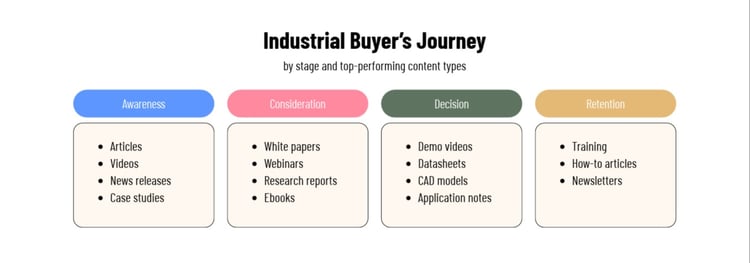
The buyer journey is the path from "we need a part made" to "we've selected a supplier." In industrial manufacturing, it usually runs like this:
- Specify. The design engineer develops the part, creates the drawings in CAD, and submits a bill of materials (BOM) to purchasing.
- Check the AVL. The buyer reviews the BOM and goes to the Approved Vendor List first. Existing suppliers are the default because onboarding a new vendor costs time and contract work.
- Search. If no one on the AVL fits, the external search begins. Buyers research online, build a shortlist, and compare options.
- Qualify. The quality engineer evaluates and audits the candidates before anyone is approved.
- Select. Procurement negotiates price, terms, and delivery, and the supplier is added to the AVL.
The part most shops miss is how much of this happens before anyone contacts you. In the 2026 State of Marketing to Engineers report from TREW Marketing and GlobalSpec, technical buyers said they complete an average of 62% of the buying process online before speaking with anyone at a supplier. By the time your phone rings, a shortlist already exists. If your shop wasn't findable and credible during steps 1 through 3, you were never on it.
The same report points to what finally gets a buyer to reach out: questions about pricing and inventory were the top trigger for first contact (26%), followed by the desire to validate information found online (23%). The rest of the research is on you to answer in advance.
Three other findings from the report shape how this plays out:
- Brand familiarity breaks ties. When evaluating two technically similar solutions, 70% of buyers said they were likely or very likely to choose the better-known brand, and 53% said brand familiarity influenced their most recent purchase. Consistent, useful content over time is how a shop becomes the familiar one.
- Search hasn't been replaced by AI, but AI is in the mix. 77% of buyers use traditional search engines more often than generative AI, while 69% use generative AI at some point in the purchasing process. They trust it cautiously: average trust was 4.7 out of 10, and only 6% said an AI-generated search summary is usually enough. Buyers use AI as a starting point and then click through to verify, so your content has to hold up when they do.
- Who writes it matters. Engineering experts at a vendor company ranked as the most trusted authors of technical content (66% rated them very or extremely trustworthy). Generative AI tools ranked last (10%).
Why This Belongs in Your Technical Content Marketing Strategy
Most shop content is written for "customers" in general. That's how you end up with a blog post that no one on the buying team finds useful. Building personas and the journey into your strategy changes that:
- Your topics get specific. You write about what each role is actually searching for: machinability, material selection, compliance and QMS, inspection processes, supplier communication, lead times.
- Your content reaches the right person at the right stage. A design engineer researching manufacturability needs something different from a quality engineer checking your audit record or a buyer comparing suppliers. You can build for all three.
- You show up before the shortlist. Since most of the research happens before contact, your content is doing the selling in conversations you'll never hear.
- You earn trust from skeptics. These readers can tell when content was written by someone who has never run a machine. Content built around real pain points, written by people who know the work, reads like it came from inside a shop.
- You can measure what's working. When each piece is written for a defined reader at a defined stage, it's much easier to tell which content brings in the right inquiries.
A simple way to apply it: match the content to the stage.
|
Stage |
Who's reading |
What they need |
|---|---|---|
|
Specify |
Design engineer |
Manufacturability, tolerancing, and material guidance they can use without a call |
|
Search |
Buyer |
Capabilities, lead times, and clear answers on cost and delivery |
|
Qualify |
Quality engineer |
Certifications, inspection processes, traceability, and compliance documentation |
|
Select |
Buyer |
Proof of on-time delivery, consistent quality, and reliability |
How to Use the Industrial Buyer Personas Cheat Sheet
The cheat sheet gives you a one-page overview of all three personas, followed by a detailed profile of each. Each profile covers the persona's role, personality and background, job functions, pain points, and topics of interest.
Here's how to put it to work:
- Start with the overview page. It shows all three personas side by side, so you can see where their concerns overlap and where they differ.
- Pick one persona per piece of content. Choose who you're writing for before you write anything.
- Pull your topics from "Topics of Interest." Use these lists to build your editorial calendar and topic clusters. They're the subjects each role is already researching.
- Lead with the pain points. Each persona's pain points tell you what to open with and what proof to include.
- Match the format to the persona. Engineers want technical detail they can verify. Quality wants documentation. Buyers want clear answers on cost, delivery, and reliability.
- Share it with your sales team. The same profiles help them prepare for conversations with each role.
If you'd rather have someone build the plan with you, that's what our Technical Content Marketing Strategy service does.
According to the same report, 85% of technical buyers are willing to share their information for technical content they find valuable. The cheat sheet is built to be that kind of resource.
Source: TREW Marketing and GlobalSpec, in collaboration with Elektor, 2026 State of Marketing to Engineers: Where Technical Buyers Turn for Answers, and Who They Trust. The survey drew responses from more than 1,000 engineers and technical professionals worldwide.