
Content marketing is a low cost way to find new customers for your machine shop. Utilizing your existing team’s capabilities, knowledge, and technology, you can develop technical content that gets your business in front of technical buyers like design engineers and procurement specialists and identifies you as both a trusted resource and partner.
Before you start writing, recording, or filming, though, you need to develop a strategy. As the saying goes, it doesn’t matter how many rungs you climb if the ladder’s leaning against the wrong wall. So take the time to assemble the main components of your marketing strategy (too many manufacturing puns?).
Your marketing strategy is broken up into the who, what, and where. That’s your audience, the content you’re creating, and where you’re publishing that content.
Let’s walk through each of these in more detail, and we’ll provide some resources you can use to flesh out your own content marketing strategy along the way.
Identify your Audience
Much of the best practices and methodologies that I’ve read tend to treat the audience step as a more of a discovery stage than a decision stage. By that I mean, it’s the business’s responsibility to understand their industry and the types of buyers that populate it. Those are the people who make up their audience, that’s who they need to develop technical content for, and that’s who they’re ultimately selling to. It’s treated as a foregone conclusion that the business needs to plan for.
That methodology is completely accurate, but I think it’s a bit more nuanced than that for manufacturers. Manufacturing is such a broad industry, and even if you focused on one niche, the sub-sectors are still very diverse.
In light of this, I think it’s a huge advantage for machine shops and other advanced manufacturers to actually be more selective with their audience than what standard inbound marketing methodologies prescribe.
Consider this series of questions that you could ask in a business development planning discussion:
- What industries are we capable of supporting?
- Which industry(ies) do we prefer to support?
- What type of companies within that industry(ies) are we capable of supporting?
- Which type of companies within that industry(ies) do we prefer to support?
- What kind of technical buyers work at these companies that we can help?
- Which kind of technical buyers do we like to help?
The questions start broad and narrow down. They move down from the industry level to the company level, and to the buyer level. And they go beyond capability to preference.
Industry
Preference matters. Just because you can support the medical industry doesn’t mean you should.
Your organization’s manufacturing capabilities may be just as well-suited to supporting the aerospace industry, and you prefer the latter’s competitive landscape to the former’s.
Instead of competing globally with aerospace manufacturing suppliers, you’re competing with just domestic ones (if you’re a US manufacturer, anyway). That improves your ability to win work at a healthy margin exponentially.
Company
Preference can also be applied at the company level. Think size, employee count, product portfolio, revenue, annual spend on outsourced manufacturing services, etc.—these factors will all impact a customer’s working relationship with their manufacturing partners.
To play out an example, consider the differences between large, medium, and small/startup OEMs.
Large OEMs
Think major automotive, aerospace, or heavy equipment giants (e.g., Ford or Boeing). They offer scale but come with bureaucracy.
- Revenue: $100M+ (often into the billions)
- Employees: 500+, with layered departments, procurement policies, and multiple facilities
- Buying behavior: Formal procurement processes, RFPs, vendor qualification requirements, and committee-based decisions involving procurement, engineering, quality, and sometimes legal/compliance. Sales cycles are long and relationship-driven at the account level, not the individual level.
- What they respond to: Authority-building content — whitepapers, certifications, compliance documentation, and thought leadership that positions you as a vetted, low-risk partner capable of scaling with them.
Medium OEMs
Often considered the “sweet spot” for many machine shops. These include mid-sized manufacturers in automotive Tier 1 supply, industrial equipment, medical devices, or specialty vehicles.
- Revenue: Roughly $10M–$100M annually
- Employees: Around 50–500, with defined departments starting to form (dedicated purchasing, engineering, quality teams)
- Buying behavior: Purchasing decisions usually involve 2–4 stakeholders — a mix of technical evaluators (engineers) and business decision-makers (ops/finance). Sales cycles lengthen; they want proof points and ROI justification, not just a handshake.
- What they respond to: Technical content that speaks to both the engineer and the budget-holder — spec sheets, comparison content, and messaging around scalability and process improvement.
Small OEMs
These are the startups, specialty manufacturers, smaller equipment makers, or niche players who prioritize speed and flexibility but lack scale.
- Revenue: Typically under $10M annually
- Employees: Usually under 50, often a tight-knit team wearing multiple hats
- Buying behavior: Decisions often made by the owner or a single leader (sometimes the same person doing sales, ops, and purchasing). Sales cycles are shorter, relationships are personal, and trust is built through direct conversation more than formal RFPs.
- What they respond to: Practical, no-fluff content — case studies, pricing transparency, and messaging that shows you understand their resource constraints. They're wary of anything that feels like it's built for "big company" budgets.
In-house capabilities, internal processes, quality standards, team, facility size, access to automation, and cash flow—these factors will give you a strong indication of which size(s) of OEMs best align with your business.
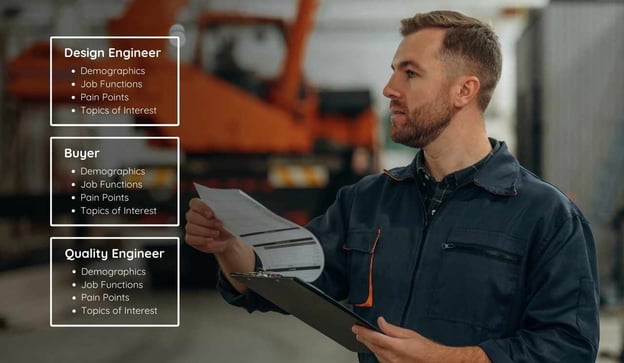
And finally, there’s the technical buyers to consider. These are the individuals who work for the OEMs that you want to do business with. They’re the design engineers, product managers, buyers, supplier quality engineers, and even C-suite level decision makers.
Each type of technical buyer cares about different things and has different pain points. Not only can you use these to your advantage in your marketing materials, but understanding each industrial buyer will highlight which one your business is inherently better suited to support.
I generally sort technical buyers into 3 categories for machine shops: design engineer, (supplier) quality engineer, and buyer. You can read about these in detail in the companion blog post Understanding Technical Buyer Personas, and download your own copy of the guide.

Choose your Topic Clusters
The next step in developing your content marketing strategy is to choose your topic clusters.
Search engines and AI engines “like” when websites organize their content around topic clusters. It means that a website is more searchable, and demonstrates an expertise in a given topic. This means that the website will rank higher in both search engine results (SERPs) or be cited in AI-generated answers.
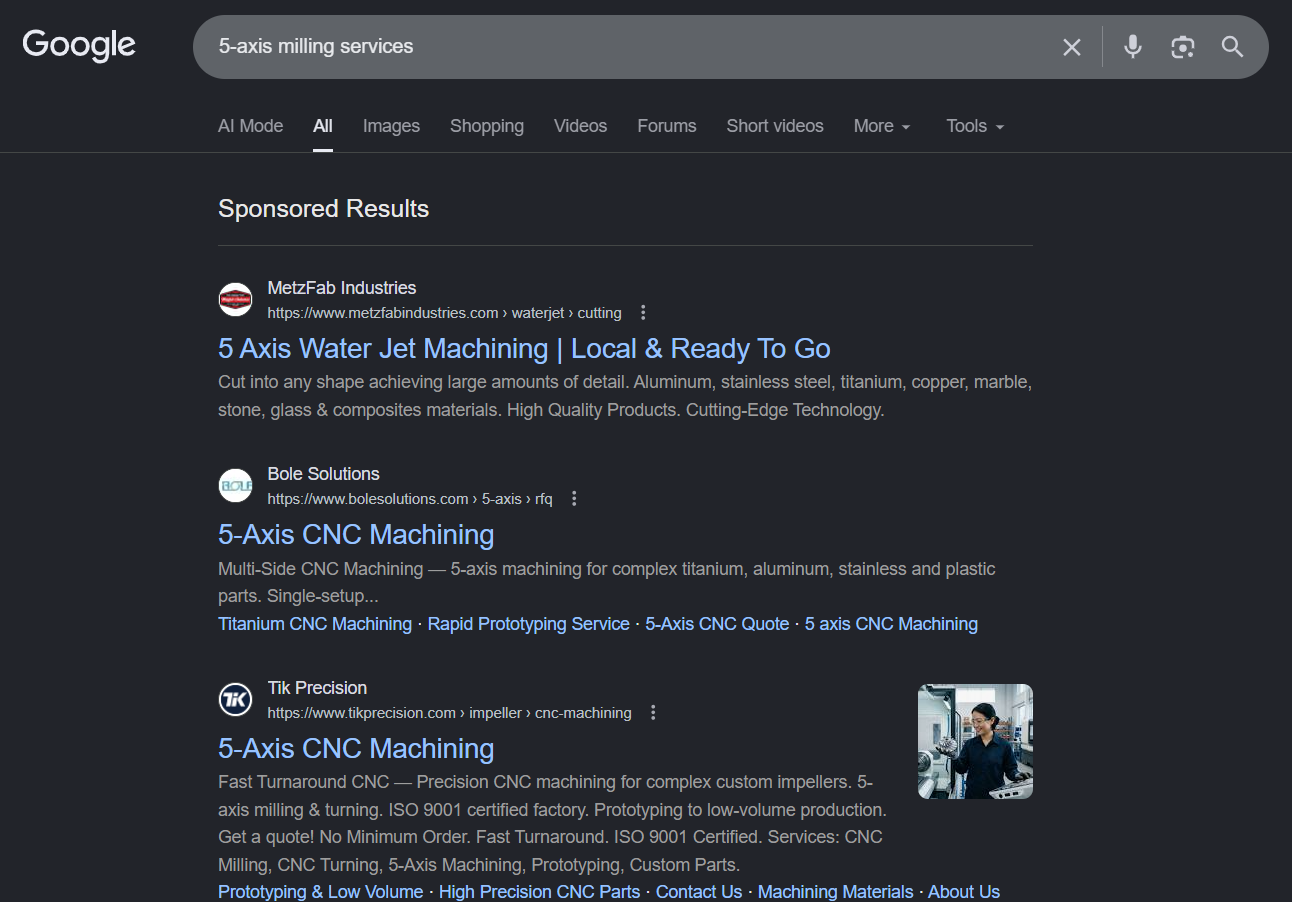
5-axis milling search engine results page (SERP)
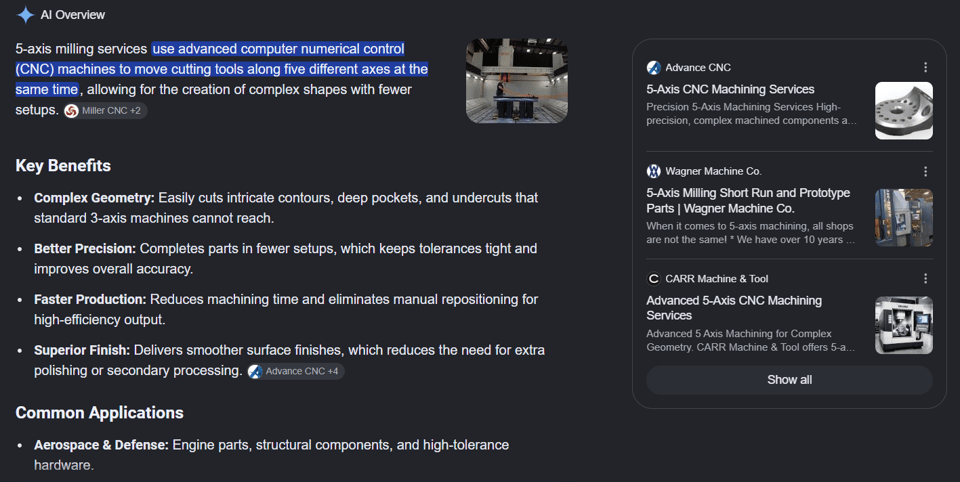
5-axis milling AI overview
The topic clusters you choose shouldn’t be arbitrary or random. They should be based on the technical buyer that you’ve identified or chosen as your audience.
Let’s use the design engineer buyer persona as an example for which topic clusters you might choose to write about. Consider their known pain points and topics of interest.
Pain points may include part manufacturability, complex geometries, tolerancing, machinability, repeatability, material selection, regulatory compliance, and part cost. These pain points represent things that engineers research and learn about with the ultimate goal of designing and producing better parts and assemblies.
Knowing this, here are some potential topics and example blog posts/articles you could contribute toward each cluster.
|
Topic Cluster |
Content Ideas |
|
Design |
Improve your Part with 10 DFM Tips How to Optimize your Technical Drawing 5 Ways GD&T gets Incorrectly Applied |
|
Material |
What to know about Machining Exotic Metals How to Choose the Right Metal for Corrosion Resistant Applications How to actually Calculate Material Cost |
|
Fabrication |
When to Choose CNC Machining or Castings Pros and Cons of Additive Manufacturing An Engineer’s Overview to Wire EDM |
Your ability to execute a content strategy is limited by your shop’s bandwidth. Most small and medium-sized machine shops don’t have a dedicated person or team that owns marketing. More than likely, it’s a facet of one individual’s job rather than their whole job.
If limited bandwidth is your reality, choose one technical buyer persona to go after. Don’t try to write to all 3 or even 2. Prioritize the buyer persona whose pain points best align with your shop’s capabilities and strengths. For some shops that will be design engineers; for others, it will be the industrial buyer or supplier quality engineer.
Decide where to Publish your Content
Where you publish your content is just as important as the content itself. All the effort put into your strategy, audience analysis, and content creation will go to your place if no one gets their hands on your content or if it isn’t visible to the right people.
Trew Marketing’s latest State of Marketing to Engineers report revealed the top places and platforms where engineers and other types of technical buyers get their research.
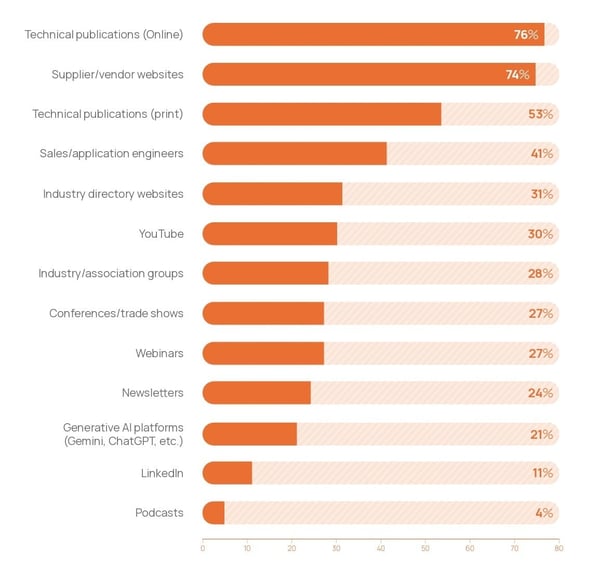
Trew Marketing, 2026 State of Marketing to Engineer's Research Report
The top 5 standouts were online technical publications, supplier/vendor websites, print technical publications, sales and/or application engineers, and industry director websites.
The channels you choose will partially be dependent on the type of content you produce. Videos like explainer and how-to’s, as well as webinars and interviews, naturally track towards YouTube. And while YouTube is a much more popular social media platform amongst technical buyers, LinkedIn is also great for video.
Based on the latest research, machine shops should prioritize publishing content to their own websites (especially given the growing use of AI for initial research) and distribute to the social media platforms that a.) are most popular among technical buyers and b.) align with the type of content they’ve produced (e.g., video, podcast, written).
Remember, don’t try to post everywhere. Be picky with your channels and go where your chosen buyer persona goes.
Some closing thoughts to consider if you made it to the end here.
Content marketing is all about the long game and rewards consistency more than perfection. It’s a low-cost way to source more qualified leads for your shop, and the best return on effort comes when you take the time to think through your strategy.
Work through the 3 steps with the right players and subject-matter experts at your shop, and constantly revisit them to make sure your strategy is doing the right work for you.
- Audience
- Topic clusters
- Channels
Measure your content’s performance and make adjustments accordingly to make sure you’re burning your marketing calories on the right audience, the right content, and the right publishing channels.
As always, drop us a line if you ever have content marketing questions.
 Amanda