

In its broadest strokes, the employee lifecycle can be captured in three stages: hiring, onboarding, and offboarding. Each of these stages represents a collection of processes, and in my experience, another effective way to treat them is as a collection of pipelines.
The goal with any stage, process, and pipeline is to move an individual from the initial phase to the final one as smoothly and efficiently as possible. This not only creates a good experience for the individual, but it’s good for the businesses on the time and cost-saving fronts.
Regardless of business or industry, it’s never good to waste time due to a broken process or clunky system. I find this especially true for manufacturers, though, and especially on the hiring front. At the time of writing this (May 2026), the unemployment rate for manufacturers is incredibly low. In fact, it was hovering at just above 3% unemployment.
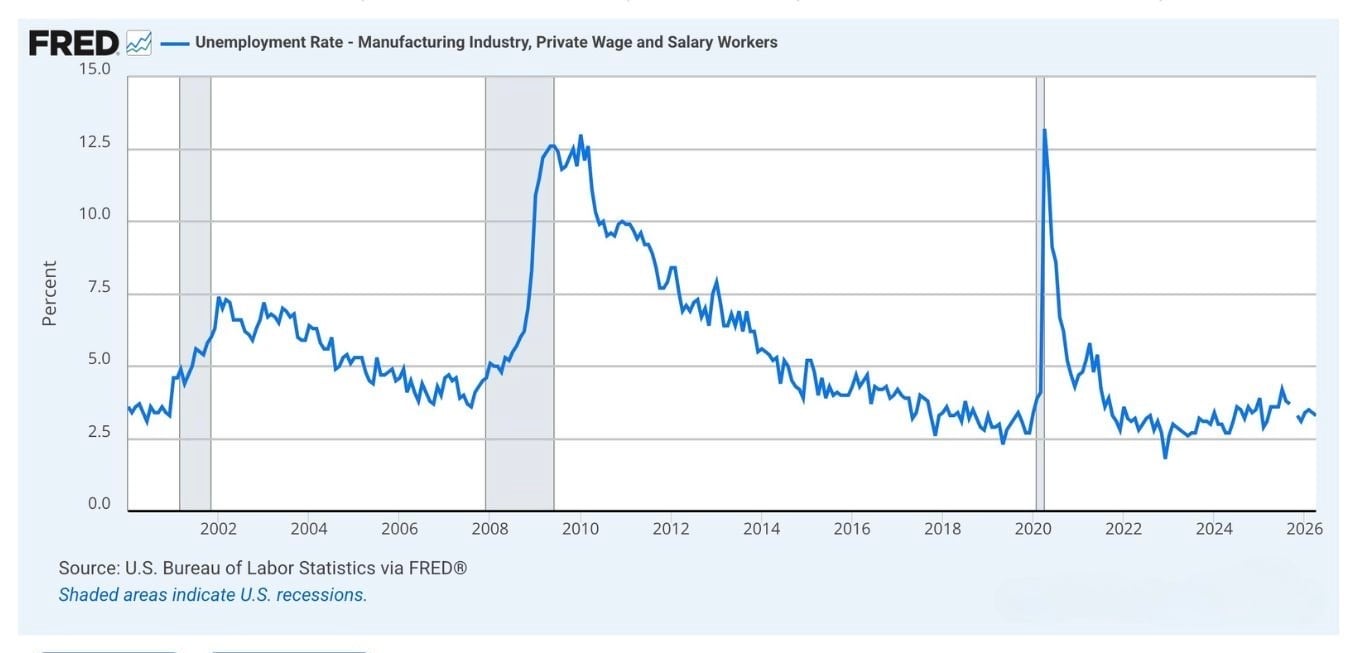
While this is great news for manufacturing employees and the country’s GDP, it does present a unique challenge for manufacturers:97% of the employees you would like to hire are already employed, meaning you have to offer more incentives for them to leave their current employer for you AND you have to provide a seamless, and fast, hiring experience.
So what do smooth, efficient employee management processes look like? How should you develop and manage your hiring, onboarding, and offboarding processes?
This post gives you a clear, step-by-step walkthrough of a proven-out hiring process and how it's executed through a custom applicant pipeline (I built mine using HubSpot's Deals and Deal workflow tools). I go through onboarding and offboarding processes in other posts.
Hiring Process and Pipeline
The process that starts it all – hiring. If your recruitment efforts prove successful, you’ll source some qualified candidates; and from the moment they hit “Submit application”, they’re officially in your hiring pipeline.
What phases should make up your hiring pipeline? What sub-processes drive the overall process that is hiring? How do you measure the efficiency of your own processes (i.e., from time of application to hire)?
Many of these questions may be answered for you if your organization uses a dedicated hiring platform like Bamboo HR or Workday. If you’re using a custom solution, though (for example, my company used HubSpot's CRM and sales tools to build a custom Applicant Tracking System [ATS] and keep the recruitment budget low) and need to build out a pipeline, here are the stages I’ve used to efficiently move manufacturing applicants through the hiring process.
Quick Note
In my experience, a recruitment specialist manages the initial screening prior to handing a candidate off to the hiring manager. Depending on your organization, you may have different roles involved in the hiring process.
Applied
This is the first stage in the hiring pipeline. It’s where new applicants land after they’ve submitted an application.
Exit criteria: the recruitment specialist confirms that the applicant has valid contact information (phone number, email address) and a resume.
Screening
The second stage in the hiring pipeline is where the recruitment specialist screens a candidate against the most basic disqualification reasons. In my experience, the most essential disqualification reasons included the following:
- Convicted of a felony
- Willingness to complete a background check
- Either lives near the facility or is willing to relocate
Exit criteria: the recruitment specialist confirms that the applicant clears the disqualification criteria and hands them off to the hiring manager OR decides to close the application.
Qualifying
The third stage of the hiring process – qualifying – is driven by the hiring manager. They’ll review the applicant’s resume, cover letter if there is one, and any additional feedback left by the recruitment specialist to determine if the applicant is qualified for the job and a potentially good fit for the team.
Exit criteria: the hiring manager determines that the candidate is qualified to be interviewed OR decides to close the application.
Interviewing
Arguably the most straightforward of the stages, this is where all the interviews happen. Depending on the role, the number of interviews you conduct will vary. There’s a fine line between thoroughly vetting a candidate and wasting people’s time.
I’ve found that an initial phone call, followed by one to two in-person interviews, is sufficient and efficient for production-related roles. If you’re interviewing for a more specialized role or a leadership position, the interviewing process could be more extensive and involve more stakeholders (e.g., a Director of Engineering or Quality).
Exit criteria: the hiring manager and relevant stakeholders (leadership, HR, supervisors and/or cell leads) determine that the candidate is a good fit and an offer should be extended.
Final Review
Think of the “final review” as a housekeeping stage. This is a good time to ask a candidate for references and also process a background check.
This stage can be completed in a day or two, typically, but do not skip it. There’s nothing more frustrating than hiring a candidate (and closing other applications in the process) only to have the new hire not work out due to reasons or circumstances that calling references or a background check could have caught.
Exit criteria: leadership has been informed that the background check and references yielded positive results and they are clear to extended an offer to the candidate.
Offer in Progress
I like to think of this as the “waiting window.” The ball is totally in the candidate’s court and you’re waiting for either an acceptance, negotiation, or rejection of your offer.
Exit criteria: the candidate either accepts or rejects your offer.

Offer Accepted (Closed Won)
To borrow from classic sales terminology, think of the “Offer Accepted” stage as a Closed-Won deal (like any deal, an application will always end in some kind of closed result).
Once your offer’s been accepted, it’s time to iron out the onboarding details - pay, start date, supervisor, and onboarding plan.
Exit criteria: the offer’s been accepted and a start date has been selected.
Application Closed (Closed Lost)
The “Application Closed” stage is where applications go if a candidate ultimately rejects your offer. This stage is unique, though, in that any application at any time can skip stages and be moved straight to this Closed-Lost stage.
Whether it’s because they didn’t pass a background check, no-showed an interview, or raised serious culture concerns, an applicant can be placed in this stage at any point in the hiring process.
Exit criteria: no exit criteria; this is really the end of the line.
A few closing thoughts if you're still with me.
Think of the hiring stages and processes I've offered here as best practices or guidance for your own recruitment strategy, especially if you're developing a custom solution. Plenty of the decisions will be made for you if your organization invests in a dedicated, out-of-the-box hiring solution.
I built my team's applicant pipeline and other recruitment processes in HubSpot because it made sense for my organization's needs and budget restrictions. This post will be the most helpful for small and medium-sized manufacturers who need an agile, affordable solution to manage their hiring.
💡 Related Read: Budget-Friendly Job Posting for Manufacturers
Drop me a line if you have questions or want more insights on how to build a custom hiring solution for your team. Each business's needs and processes will differ from the next, but it's worth putting the time and effort into creating a streamlined hiring process and bulletproof hiring platform so that your candidates have a good experience and your team can process applicant's in a timely manner.
Remember: 97% of the manufacturing workforce is already employed (Q1 2026 data). Your team needs to move fast, without comprising on quality, to meet their recruitment goals. The competition is fierce and manufacturing professionals are moving fast these days.
 Amanda